Event record
A seated talk for people who sell hotel rooms.
HBF-2026 is a two-day forum for the hotel business in Moscow. The talk sat in the «Контуры будущего» (Contours of the Future) track on the first day. It was planned for 45 minutes, 30 of talk and 15 of Q&A, and ran for 90, from 12:45 to 14:15.
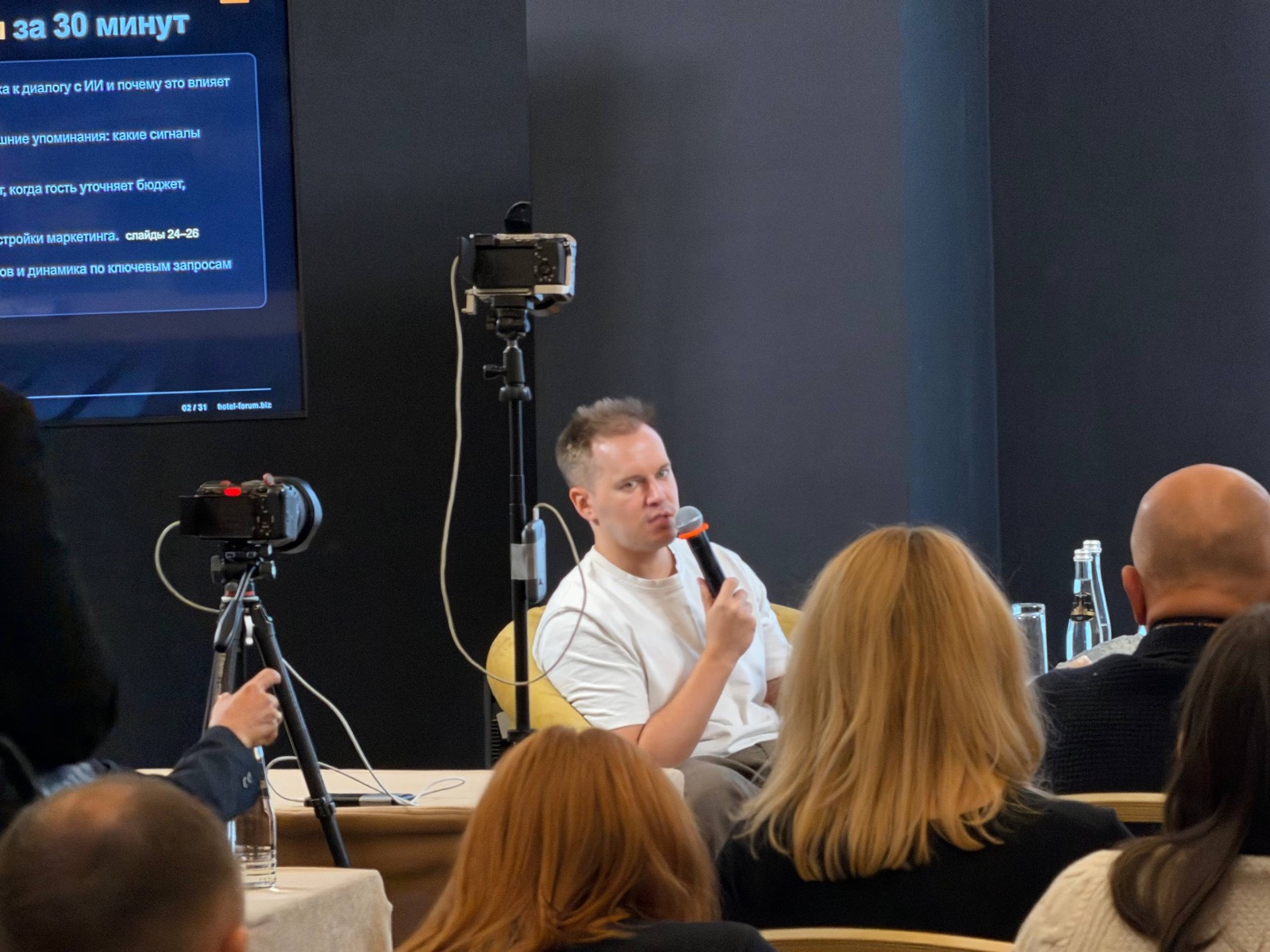
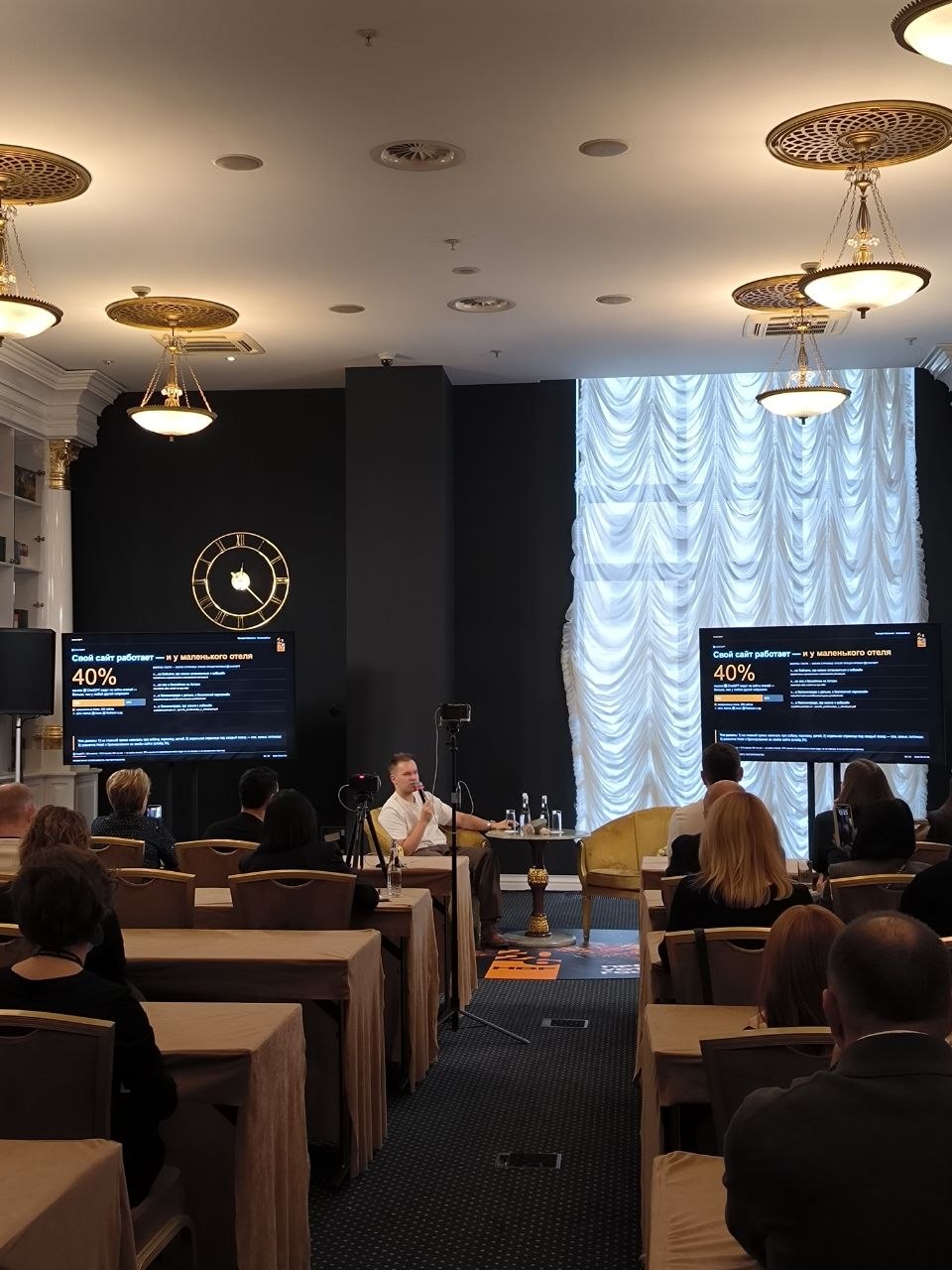
The format was a seated talk with a microphone and two screens, one on each side of the stage. The deck had 27 slides, all in Russian, opening with five questions the session promised to answer: how the guest journey moves from search results to a ready AI answer; where AI learns about a hotel; why a hotel drops out once the guest adds conditions; what to change this season; and how to measure the result against competitors.
Event facts
The talk at a glance.
| Event | HBF-2026 Hospitality Beyond Future, the hotel business forum. |
|---|---|
| Date and city | November 23, 2026, Moscow. |
| Venue | Radisson Collection Moscow, Kutuzovsky Prospekt 2/1. |
| Talk | «Почему ИИ рекомендует не ваш отель — и как это изменить» (Why AI recommends someone else's hotel, and how to change it). |
| Time | 12:45–14:15, 90 minutes including Q&A. |
| Audience | The hotel business: owners, managers and marketing teams. |
| Data | Humanswith.ai study collected on November 12, 2026: 7 AI engines, 100 guest questions, 10 regions, 697 of 700 answers, 4,237 cited links. |
| Materials | Slides PDF (RU) and the full study (RU). |
The study
One hundred guest questions, none of them naming a hotel.
We asked seven engines the same 100 questions on November 12, 2026: Yandex Alice, Yandex AI mode, GigaChat, ChatGPT, Gemini, Google AI Overviews and Google AI Mode. The questions covered ten regions, from Moscow and Saint Petersburg to Altai, Karelia and Lake Baikal, and seven occasions a guest actually has: a plain recommendation, a business trip, a weekend for two, a budget stay, a spa, a view, a dog. Thirty more questions formed a ladder of follow-ups on top of "with children". No question named a specific hotel: the point was to see whom each engine would pick on its own.
Before the data, the talk set one frame for the room. By our estimate for autumn 2026, about 65% of all questions Russians put to search and AI go to Yandex (search with its AI answers, plus Alice), about 19% to Google and about 10% to ChatGPT. That is a calculation from StatCounter, Mediascope and survey data, not a direct measurement, and it was shown as such. It still changes the order of work: for a Russian hotel, Yandex is the main ecosystem, not one engine on a list.
Key findings
Five findings from the talk.
1. Each engine keeps its own directory of hotels
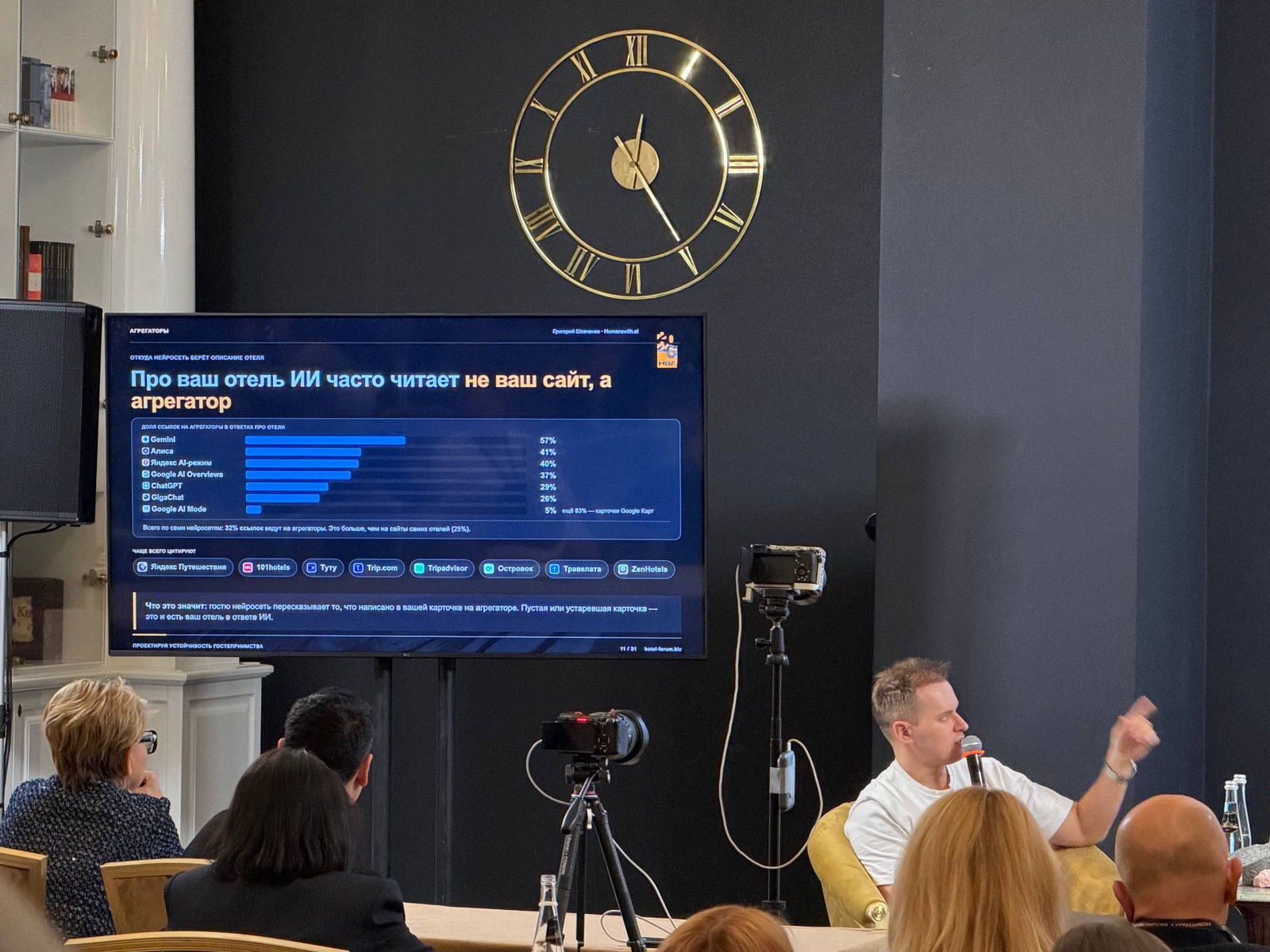
The share of cited links that lead to the hotel's own website ranged from 40% for ChatGPT to 7% for Google AI Mode. Across all seven engines, three quarters of the links went elsewhere: 3,169 of 4,237.
| Engine | Main source | Second source |
|---|---|---|
| ChatGPT | hotel website, 40% | aggregators, 29% |
| Gemini | aggregators, 57% | media and guides, 13% |
| Google AI Overviews | aggregators, 37% | hotel website, 32% |
| Google AI Mode | Google Maps listings, 83% | hotel website, 7% |
| GigaChat | media, guides and blogs, 38% | aggregators, 26% |
| Yandex Alice | aggregators, 41% | media and guides, 15% |
One slide carried the point in a single line: about your hotel, AI often reads not your site but an aggregator listing. An empty or outdated listing on 101Hotels, Yandex Travel or Ostrovok is, for most engines, the hotel.
2. Yandex recommends different hotels from everyone else
71% of the hotels Alice named were not named by ChatGPT, Gemini, GigaChat or Google for the same question. The sites themselves overlap: 103 of the 133 domains Yandex cites are cited by some other engine too. The sources are shared; the hotels Yandex picks from them are its own. A report that says "ChatGPT recommends us" tells a hotel nothing about Alice.
3. Getting into the first answer is half the job
Guests don't ask once. We followed ChatGPT through a ladder of conditions: with children, then free parking, then a dog, then breakfast under 8,000 roubles a night.
| Step | Guest adds | Hotels from the first answer still in the answer |
|---|---|---|
| 0 | with children | 46 |
| 1 | free parking | 9 |
| 2 | a dog | 2 |
| 3 | breakfast, under 8,000 roubles | 4 |
Chains did well in the first answer and fell away on the follow-ups. The hotels that reached the end were mostly independents whose home page stated parking, pets, children and breakfast in plain text.
4. In a real conversation, the first favourite rarely wins
We ran 30 five-turn dialogs, one per region for ChatGPT, Gemini and Google AI Mode, ending with "if you had to pick one hotel for us, which and why?". In none of the ten regions did all three engines pick the same hotel. ChatGPT's final choice was first in its opening list in one region out of ten. And in 40 of its 50 answers ChatGPT wrote some form of "check with the hotel" or "not stated on the website" about parking, the dog's weight limit or a breakfast rate. Each of those is a guest handed to the hotel next door that did state the fact.
5. The more conditions, the more often AI hands the guest to an aggregator
On the first question of the ladder, 14% of cited links across five engines led to aggregator collection pages such as "hotels with children" or "pets allowed". On the last question it was 32%, and for Gemini 62%. A guest who books through a collection page is a guest the hotel pays commission on.
The argument
AI doesn't guess. It looks for confirmation, and a hotel can supply it.
The practical half of the talk rested on one measurement. We read the home pages of 435 hotels with their own website and checked what was written there, then looked at how often an engine recommended the hotel when the guest asked about exactly that topic.
| Topic of the guest's question | Not mentioned on the home page | Stated on the home page |
|---|---|---|
| Dog or pets | 19% | 55% |
| Parking | 22% | 50% |
| Children | 31% | 49% |
For pets, parking and children the difference held up statistically; for price in roubles it was too small to rule out chance. So the advice for this season was unglamorous. State every occasion and condition in plain text on the site, the map listings and the aggregators, and keep the facts identical everywhere. Give each occasion its own page: 37% of ChatGPT's links to independent hotels pointed to an inner page such as a pets policy or a family offer, not the home page. Then measure what a guest actually sees in Alice, ChatGPT and Google, not what an API returns.
Measuring also means measuring more than once. In earlier runs, asking the same question again changed 31–42% of the answer, so a single run is a starting point, not a verdict.
From the room
Photos from the session.
Limits
What these numbers don't say.
It is one collection, on November 12, 2026, from Moscow addresses; ChatGPT and Gemini don't serve Russia directly, so questions to them carried the note "I am in Russia". The ecosystem shares are an estimate, not a measurement. Hotel websites were recognised by domain, so their share of links is probably understated. And a link in an answer is not a booking: how many guests then booked, we don't know.
Sources
The study and the materials.
The canonical write-up on the Humanswith.ai blog: source shares for all seven engines, the follow-up ladder, the Yandex overlap, 435 hotel websites, 30 dialogs, schema.org, methodology and FAQ.
Slides PDF (RU)The 27-slide deck as presented at HBF-2026 on November 23, 2026.
Talk entry on the speaking pageDate, venue, track, duration and links to the slides and materials.
Talk materials (Google Drive)The original deck and accompanying files from the session.
HBF-2026 Hotel Business ForumThe organiser's forum page: HBF-2026 Hospitality Beyond Future, November 23–24, 2026, Moscow.
Related