Event record
A business breakfast built around verified 2026 data.
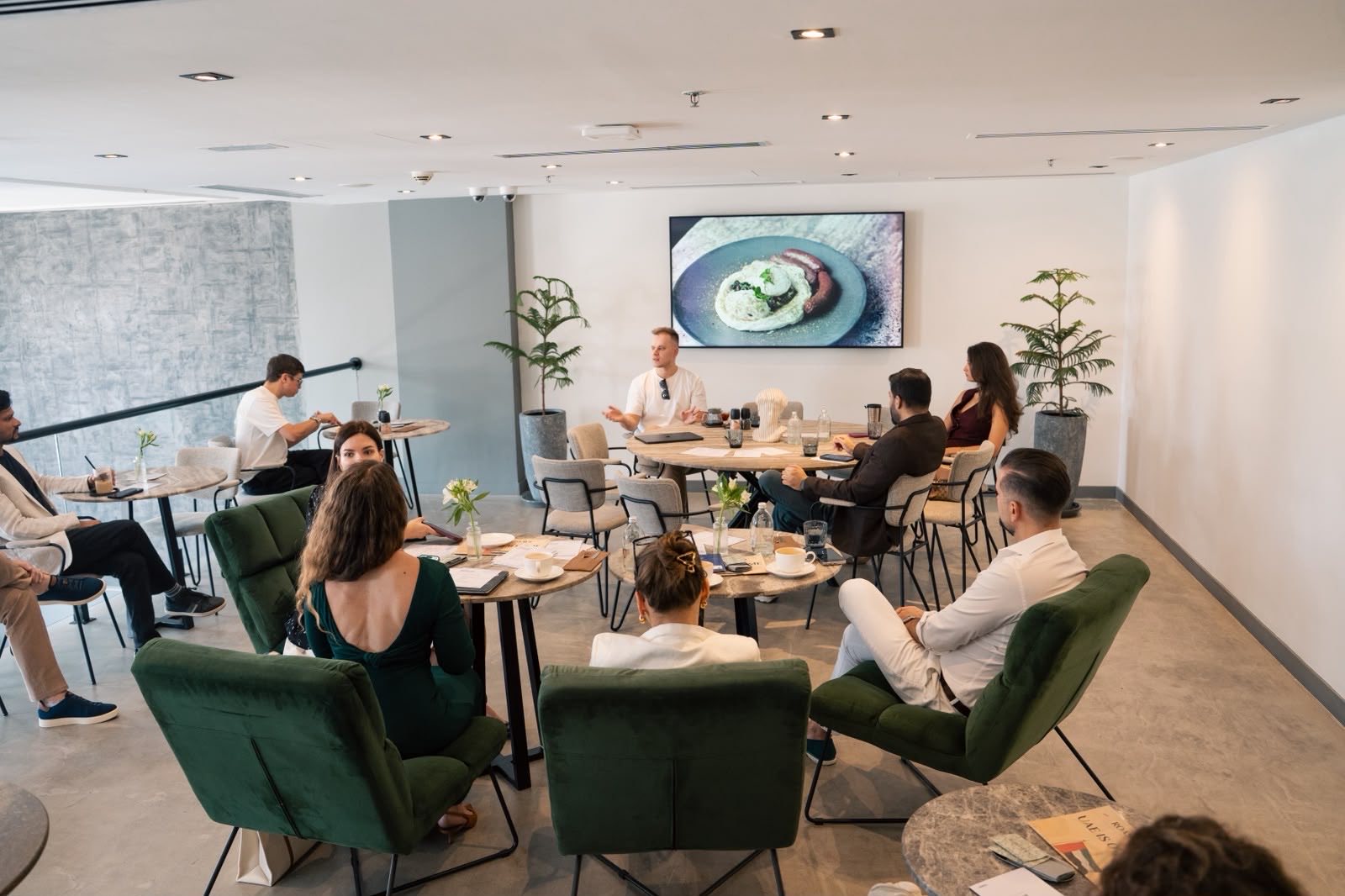
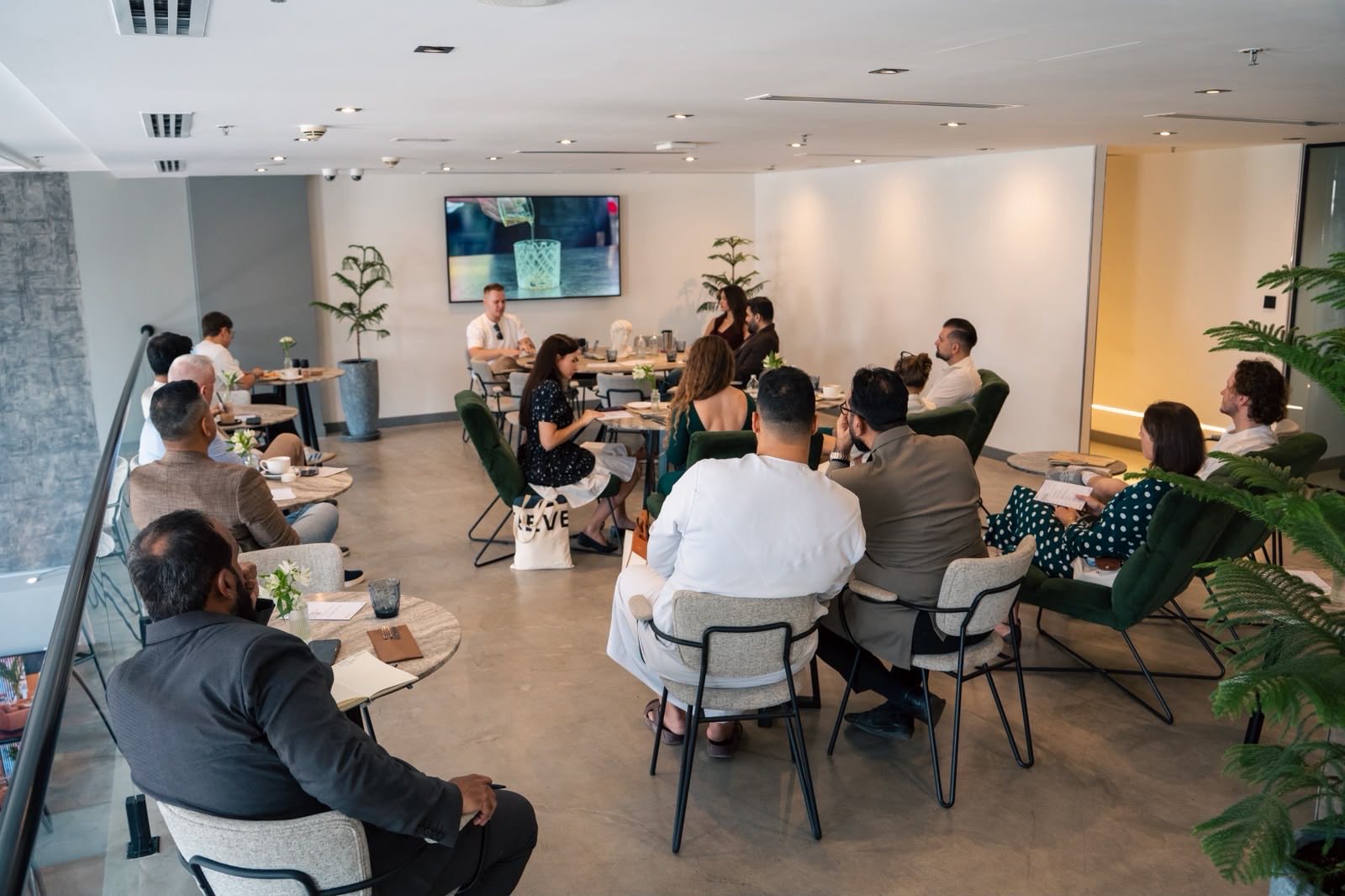
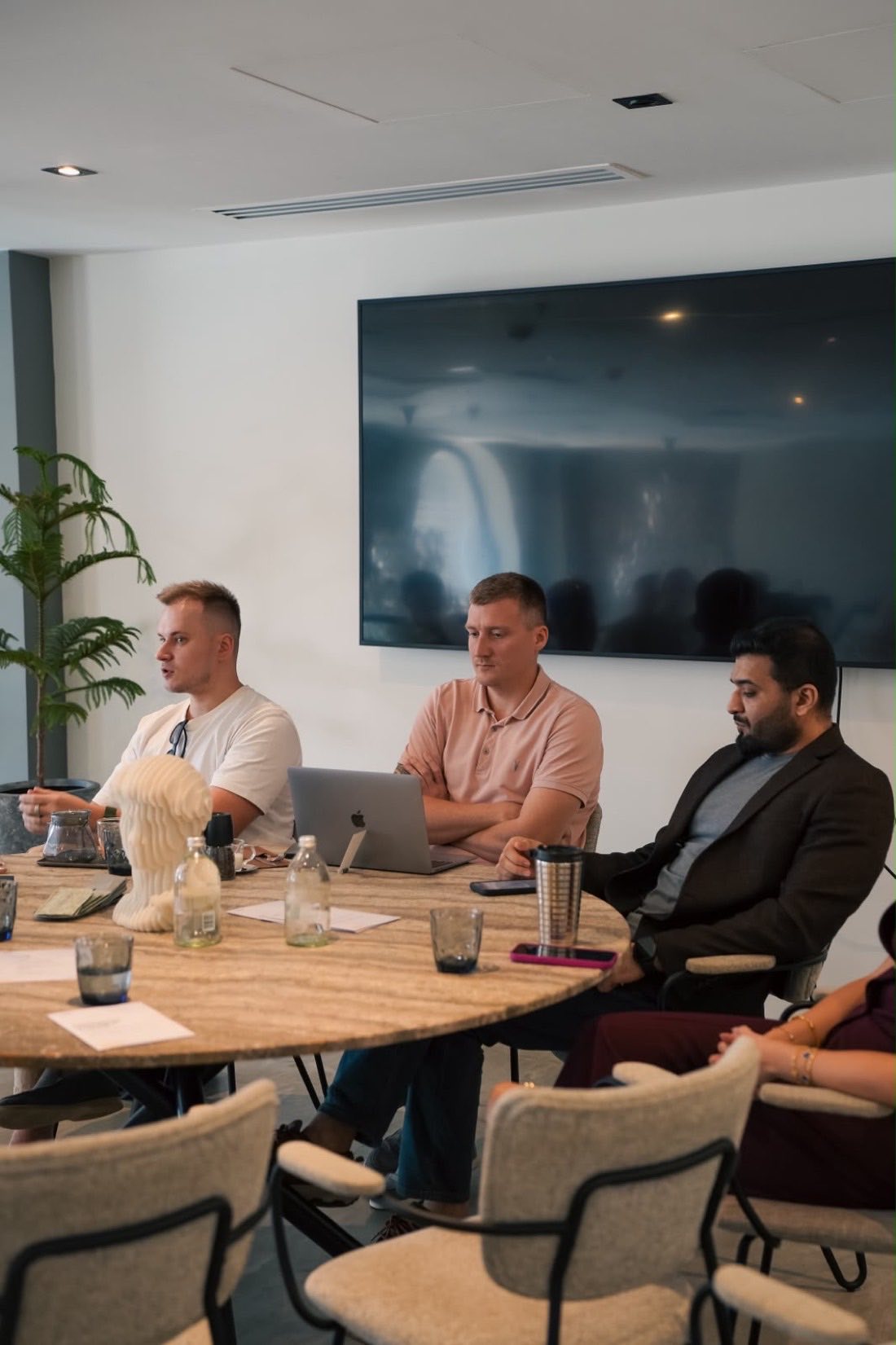
Semantica.ae organized the breakfast as a moderated session for Dubai-based marketing leaders, CMOs, and founders. The format was a 22-question interview across four parts, with Nouman Gill (Director of Growth Marketing at Xiaomi) as moderator and Gregory Shevchenko (Humanswith.ai) and Kathrine Hamdan (PR Manager at PRHub.ae) as the two expert panelists. The room included senior marketers from Emirates NBD, Dubai Airports, Danube Properties, Apparel Group, Reckitt, Cleartrip, Devsinc, and other regional companies.
Every statistic presented was checked against external primary sources before the session. The key numbers: UAE leads global AI adoption at 70.1% of the working-age population (Microsoft AI Diffusion Report Q1 2026), 68% of Google searches now end without a click (SparkToro and Similarweb, January to April 2026), 84% of AI citations come from earned media (Muck Rack Generative Pulse, May 2026, 25 million-plus links analyzed), and ChatGPT traffic converts at 14 to 16 percent compared to 1.76 percent for Google organic (Seer Interactive and Ahrefs, 2026).
Event facts
The format was a moderated panel with verified data.
| Event | Semantica.ae Business Breakfast: AI Search and Marketing Automation. |
|---|---|
| Date and city | August 8, 2026, Dubai, UAE. |
| Venue | Roasters JBR, Dubai. |
| Format | Moderated 22-question panel across four parts, followed by audience Q&A and networking. Billed on the program as a candid, no-slides hour on AI visibility. |
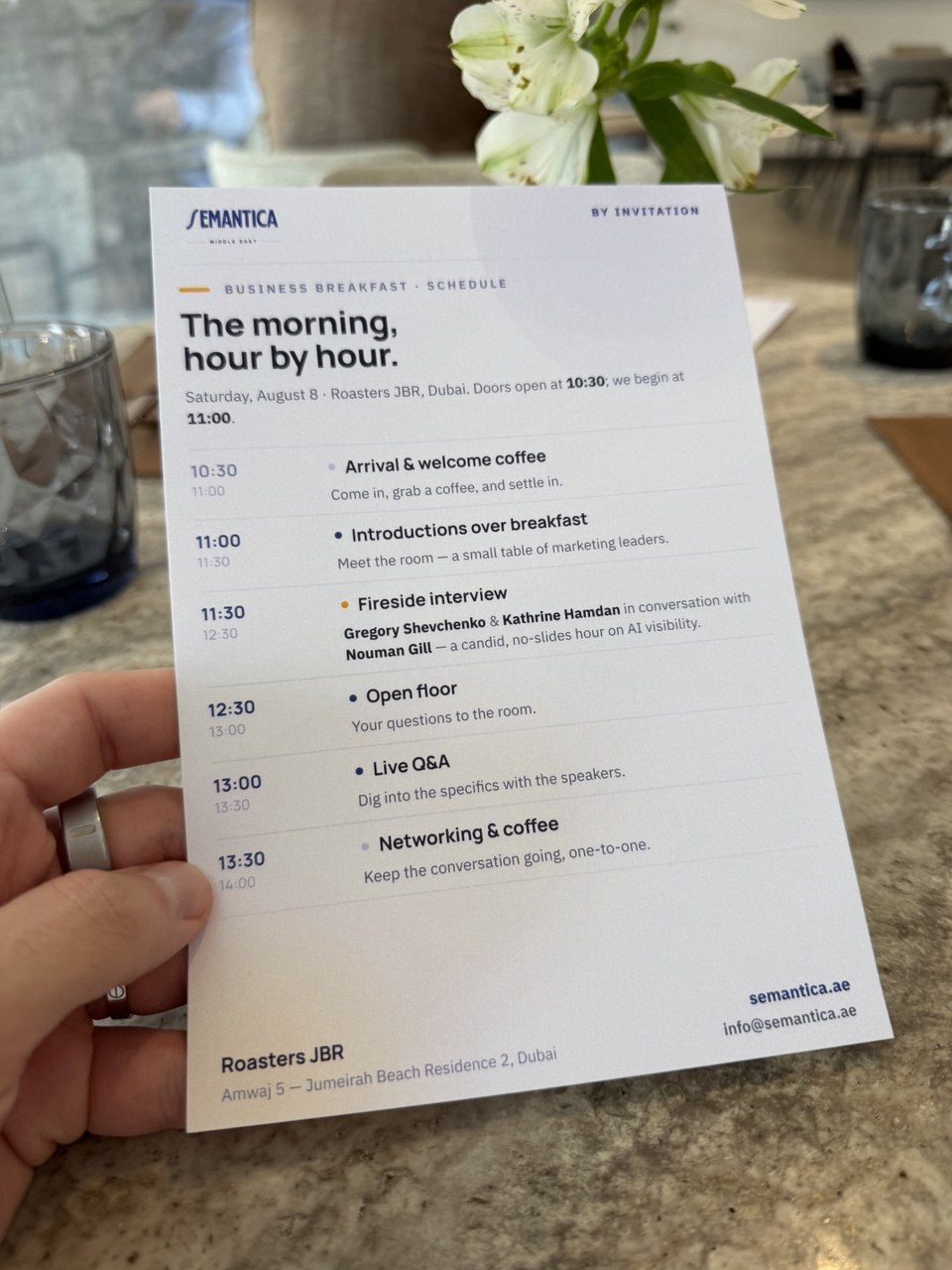
| Schedule | Doors 10:30, introductions over breakfast 11:00, fireside interview 11:30–12:30, open floor 12:30–13:00, live Q&A 13:00–13:30, networking 13:30–14:00. |
| Moderator | Nouman Gill, Director of Growth Marketing at Xiaomi. |
| Panelists | Gregory Shevchenko (Humanswith.ai) and Kathrine Hamdan (PR Manager at PRHub.ae). |
| Audience | Senior marketers, CMOs, and founders from UAE-based companies including Emirates NBD, Dubai Airports, Danube Properties, Apparel Group, Reckitt, Cleartrip, and Devsinc. |
| Gregory's role | Expert panelist covering AI search visibility, earned media, and marketing team automation with AI agents. |
Key arguments
Four parts: the shift, the hard truths, what to do, the future.
Part 1: The Shift
The session opened with the UAE's position as the global leader in AI adoption. The Microsoft AI Diffusion Report for Q1 2026 places the UAE at 70.1% of the working-age population using generative AI, up from 59.4% in the first half of 2025. Singapore follows at 63.4%, with the global average at 17.8%. The Stargate UAE project, a partnership between G42, OpenAI, Oracle, Nvidia, Cisco, and SoftBank, is building a 1-gigawatt compute cluster in Abu Dhabi with the first 200 megawatts coming online in 2026.
Gregory argued that the window for brands to establish AI visibility is closing. With 68% of Google searches ending without a click and 37% of consumers now starting their search with AI tools rather than Google, the brands that structure their content and earn third-party citations now will lock in a compounding advantage. Only 14% of marketers currently track AI search, which means the cost of catching up rises the longer a brand waits.
Part 2: The Hard Truths
The second part addressed the disconnect between Google rankings and AI visibility. The overlap between Google top-10 organic results and AI citations dropped from approximately 76% in July 2025 to 17 to 38% by March 2026, according to Ahrefs and BrightEdge analysis. A separate study by EMGI in April 2026 found that 44% of SaaS brands ranking in Google's top 10 receive zero mentions from ChatGPT for the same keywords.
Kathrine Hamdan made the case for earned media as the new discovery engine. Muck Rack's Generative Pulse report, analyzing 25 million-plus links across ChatGPT, Claude, and Gemini, found that 84% of AI citations come from earned media sources. Paid and advertorial content accounts for just 0.3%. Profound's analysis of 27 million citations found that 97.4% of earned media citations come from non-Tier-1 publications: trade publications, niche industry blogs, specialist review sites, and regional outlets.
Part 3: What To Do
Gregory outlined a four-step Monday-morning plan: ask AI platforms the exact questions your customers ask and see who gets cited, add or clean up schema markup on high-intent pages, rewrite those pages to answer the question in the first few lines, and put one tracking tool in place so the next quarter's conversation is data-driven. The key metric to track is Share of Voice in AI answers: the percentage of relevant AI responses that cite your brand compared to competitors.
On the automation side, Gregory demonstrated how a single marketing operator can run 120-plus monthly content units through an agentic workspace, replacing the traditional multi-role content team. The old model spreads ownership across a marketing manager, AEO analyst, copywriter, designer, publisher, and SEO specialist. The new model routes the same work through an agentic team workspace with one human accountable for quality and pace.
Part 4: Region and Future
The closing segment addressed the biggest blind spot for brands in the region: treating AI search as an imported trend that will arrive eventually. Local competitors are already positioning to out-cite slower brands in the UAE market. Gregory highlighted two forward-looking areas: video, with YouTube already one of the strongest correlating factors for AI Overview citations, and agentic AI, where assistants will move from recommending products to completing purchases on behalf of users.
The argument
Marketing stopped being a single-channel job — and that is an automation problem before it is a channel problem.
The through-line across the 22 questions was not AI search on its own. It was what AI search does to the shape of a marketing team. Marketing used to be single-channel: a small or mid-market company could win with one channel and a couple of freelancers. That era is over. Buyers are scattered across channels, AI answers added an entirely new one, and staying competitive now takes a precise multichannel machine — paid, organic, content — aligned with sales. That is a full team most SMB and mid-market companies cannot afford, and it is simultaneously the only way left to compete.
Automation is what makes that team possible without hiring it. Gartner's survey of 402 CMOs, published in May 2026, puts AI-driven automation at 16% of marketing work in 2026 and rising to 36% by 2028. Gregory's reading of that number: it is not a productivity tweak at the margin. It is the difference between a company that can field a multichannel team and one that cannot.
Why this only became possible recently
Properly automating a marketing department was not achievable before agentic coding tools — Claude Code, Codex, and the like — became usable by non-engineers. The unlock is that a marketer becomes an engineer who orchestrates agents rather than a manager who briefs people. The concrete shape at Humanswith.ai: one human operator plus eighteen configured agents covering the roles a six-to-ten person team used to hold — analyst, copywriter, content manager, SEO specialist, designer. Output moved from 10–12 articles a month to 100–120, at roughly half the budget. Those are the company's own operating numbers, presented as such.
AI search is a new channel, not a special case of SEO
Gregory made the case for starting there for two reasons. The first is that the moats do not transfer. SEO spent two decades building defenses that protect incumbents; AI engines instead favour fresh, well-structured, well-cited content, and there is not yet enough of it to answer most prompts well. Competition has not settled, so a young company can enter AI answers about as fast as the largest player in its category — which is not true of a mature Google SERP. The second is that the disconnect is now measurable: the overlap between Google's top-10 and AI citations fell from roughly 76% in July 2025 to between 17% and 38% by March 2026, and 44% of SaaS brands ranking in Google's top 10 get zero ChatGPT mentions for the same keywords.
And it has to start automated
This was the part most directly aimed at the room. AI visibility is not a project with an end date. Answers are regenerated continuously, cited pages age out as fresher material appears, and competitors keep publishing — so the citation set behind any given prompt looks different from one quarter to the next. A one-off audit tells you where you stood; it cannot hold a position. That is the honest reason the loop at Humanswith.ai was built as agents rather than as another service line: the work is weekly, repetitive, and measurable, which is exactly the shape of work that should not be done by hand.
The proof points offered were the company's own and a client's. Humanswith.ai ran the playbook on its own brand first, going from 2 AI citations to more than 1,000 in three months, then replicated it for Birdview, a B2B SaaS in the project-management category, which went from a 0.9% to a 21.5% ChatGPT mention rate in eight weeks and started appearing in answers next to Monday.com, Wrike, and Asana.
From the room
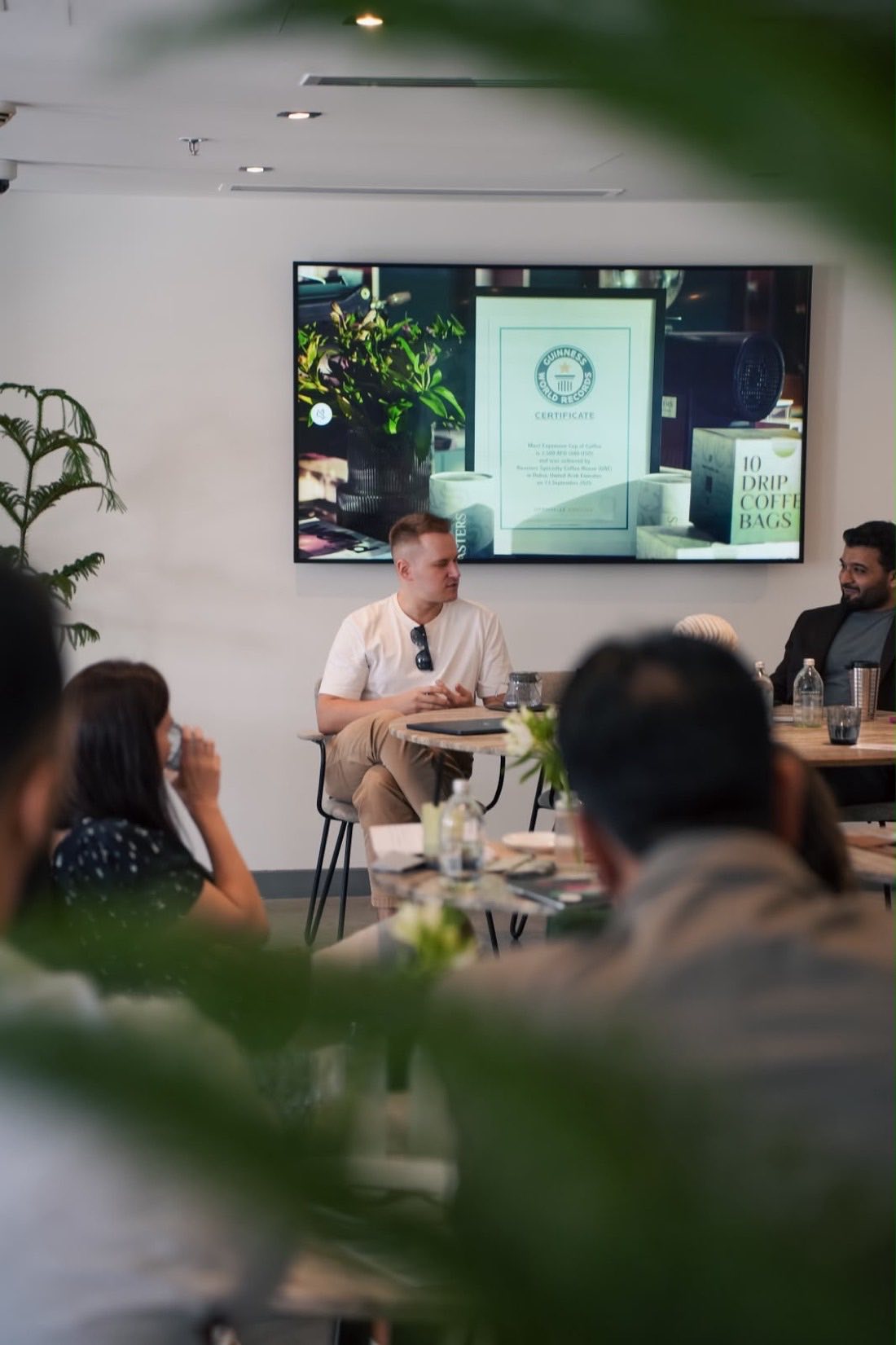
Photos from the morning.
Sources
Verified data presented at the session.
Source for UAE AI adoption at 70.1%, global average at 17.8%, and the National AI Leaderboard ranking. Published by the Microsoft AI Economy Institute, May 7, 2026.
SparkToro and Similarweb zero-click search studySource for 68% of Google searches ending without a click, January to April 2026 data.
Muck Rack Generative Pulse, May 2026Source for 84% of AI citations coming from earned media, 25 million-plus links analyzed across ChatGPT, Claude, and Gemini. Published May 7, 2026.
Profound citation categories analysisSource for 97.4% of earned media citations coming from non-Tier-1 publications, based on 27 million citations across ChatGPT, Gemini, and AI Overviews.
EMGI SaaS AI Citation Gap Report 2026Source for 44% of Google top-10 SaaS brands receiving zero ChatGPT mentions, based on 150 SaaS companies across 120 keywords, April 2026.
Eight Oh Two 2026 AI and Search Behavior StudySource for 37% of consumers starting searches with AI tools instead of Google, based on a survey of 500 active AI users.
Deloitte Digital Consumer Trends 2025Source for 58% of UAE and KSA consumers using generative AI tools such as ChatGPT and Google Gemini, based on a survey of 2,000 consumers aged 18 to 50.
OpenAI Stargate UAE announcementSource for the Stargate UAE project: 1-gigawatt compute cluster in Abu Dhabi, partnership with G42, Oracle, Nvidia, Cisco, and SoftBank, first 200 megawatts in 2026.
Gartner CMO survey, May 2026Source for AI-driven automation rising from 16% of marketing work in 2026 to 36% by 2028, based on a survey of 402 CMOs conducted August through October 2025. Published May 11, 2026.
Birdview PSA case studySource for the 0.9% to 21.5% ChatGPT mention rate over eight weeks in the project-management cluster, and for appearing in answers alongside Monday.com, Wrike, and Asana.
Humanswith.ai dogfood case studySource for the company's own brand going from 2 AI citations to more than 1,000 in three months, with 819 AI mentions and a 15.4% visibility share in the final month.
Semantica business breakfast program materialsGoogle Drive folder with the event program, agenda, and additional materials from the August 8, 2026 business breakfast.
Semantica.aeCo-host of the business breakfast. Semantica provides AI search visibility tracking across ChatGPT, Google AI Overviews, Gemini, and Perplexity for brands in the MENA region.
Nouman Gill — LinkedIn.comModerator and Director of Growth Marketing at Xiaomi. LinkedIn profile confirms his role at Xiaomi Technology in Dubai and prior experience at Etisalat (e&).
Kathrine Hamdan — LinkedIn.comPanelist and PR Manager at PRHub.ae in Dubai. LinkedIn profile confirms her role at PRHub.ae and prior experience at Umami Comms DMCC.
Related